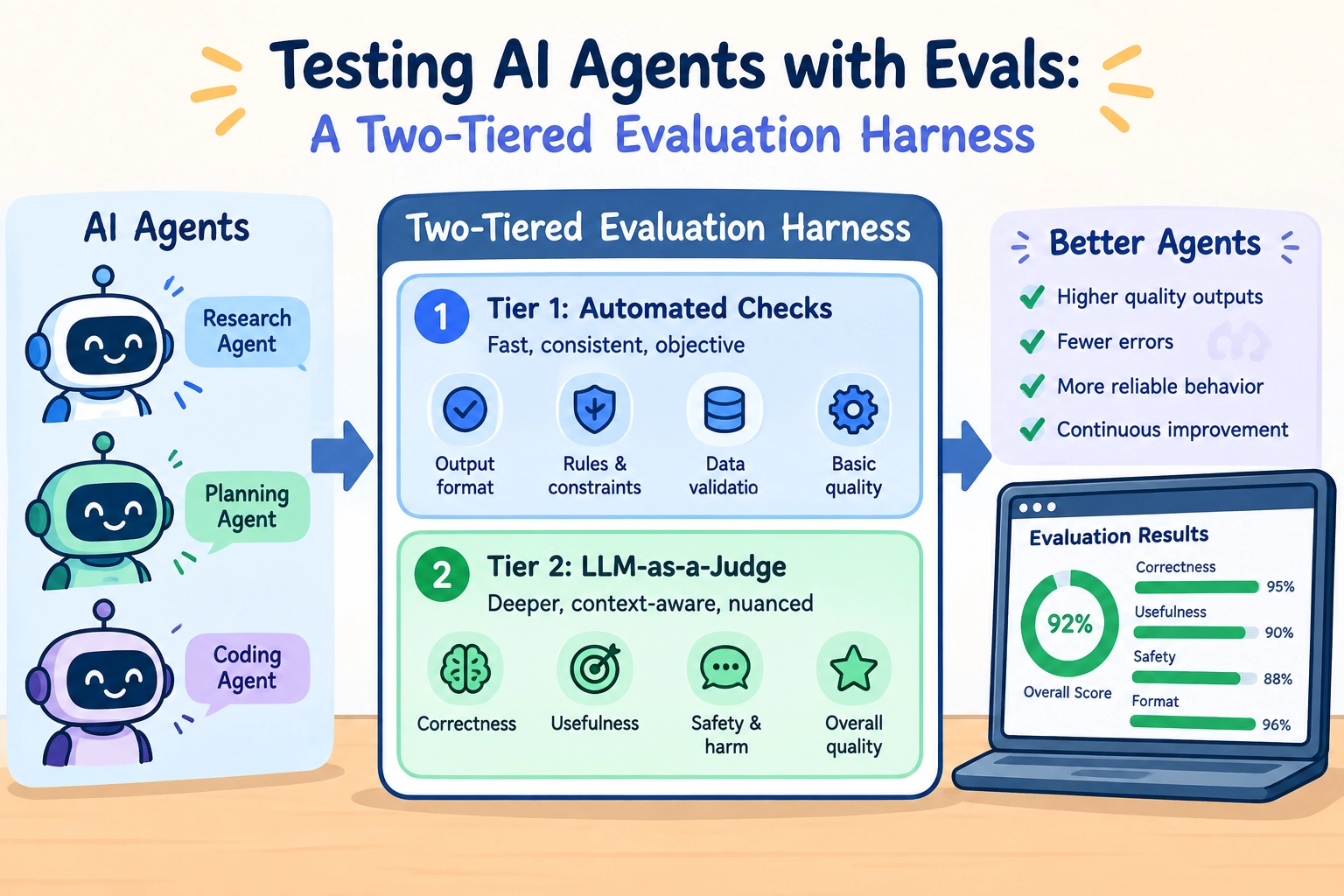
Testing AI Agents with Evals
AI agents are probabilistic. The wording can change between runs, the agent may take different paths through its tools, and a slightly different response doesn’t necessarily mean the agent made a wrong decision. This mmakes it challenging for traditional software testing to produce reliable and actionable results and findings.
Using an LLM to judge every test isn’t the answer either. It adds latency, cost, and another source of variability to the test suite.
So the aim of this project was to solve a practical problem:
How do we build a reliable evaluation suite for AI agents without turning every test into an expensive LLM call?
The approach I built is a two-tiered evaluation harness:
deterministic checks first, semantic evaluation second.
What I Built
I built the test around an automated customer support triage agent.
The agent evaluates return and refund requests against store policies and decides whether to:
issue_refundreject_policyescalate_to_human
It also generates the response to the customer. The evaluation checks each execution trace in two stages:
Tier 1 — Deterministic Guardrails
Pydantic (what does pydantic mean in this context) validates the output structure and enforces business rules such as:
- Valid actions only
- Confidence scores between
0.0and1.0 - Rejected refunds cannot authorize a payout
- Refunds require an order ID
Tier 2 — Semantic Evaluation
DeepEval (link and explanation what it is) evaluates things that are harder to express as deterministic rules:
- Faithfulness — is the response grounded in the retrieved policy context?
- Answer Relevancy — does the response actually address the customer’s question?
If Tier 1 fails, Tier 2 is skipped.
That gives us a simple fast-fail mechanism: don’t spend LLM tokens evaluating an output that has already failed a basic business rule.
The Architecture
The idea is as follows:
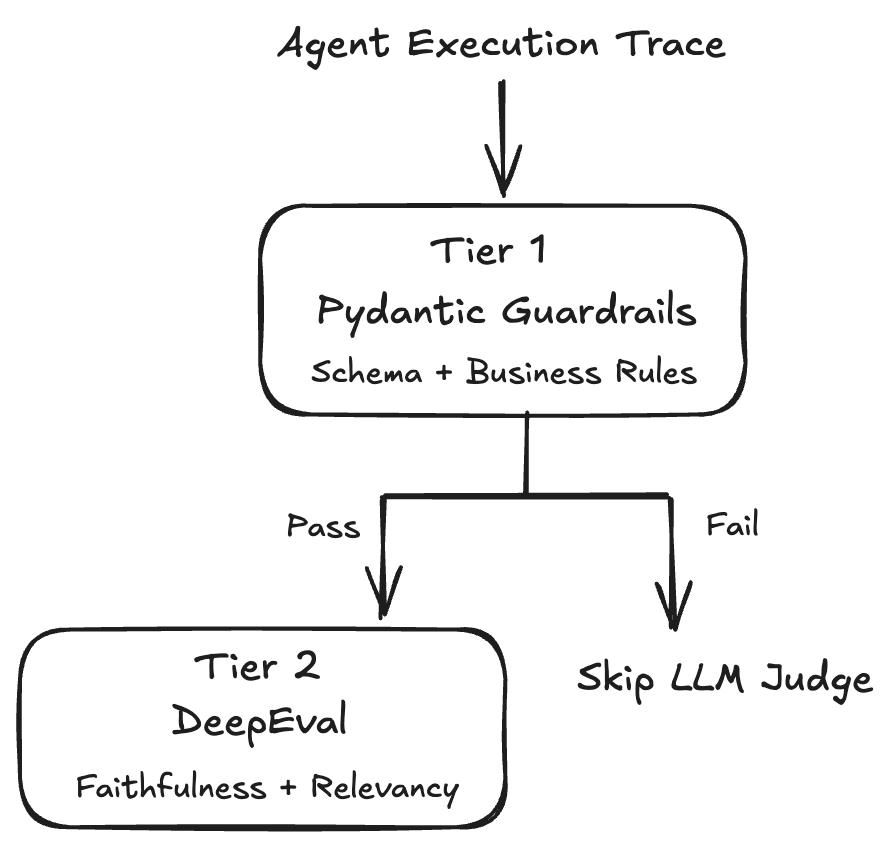
Use code for deterministic rules and LLMs for semantic evaluation.
Tier 1: Deterministic Guardrails
Before calling an LLM judge, I validate everything that can be checked with normal code. A simplified version looks like this:
validate_trace(trace):

    assert trace.action in [
        "issue_refund",
        "escalate_to_human",
        "reject_policy"
    ]

    assert 0.0 <= trace.confidence_score <= 1.0

    # A rejection must never authorize a payout
    if trace.action == "reject_policy" and trace.refund_amount > 0:
        fail("Rejected refunds cannot authorize payouts")

    # A refund requires an order ID
    if trace.action == "issue_refund" and not trace.order_id:
        fail("Cannot issue a refund without a valid order_id")

    # High-confidence cases should not be escalated
    if trace.action == "escalate_to_human" \
            and trace.confidence_score >= 0.85:
        fail("High-confidence cases must not be escalated")
These checks are deterministic, fast, and require no external API calls. More importantly, the rules are explicit and easy to understand. If the business rule says a rejected refund cannot contain a payout, Python should enforce that rule — not another LLM.
Tier 2: Semantic Evaluation
A structurally valid response can still be wrong. For example, the agent could return a perfectly valid refund decision but tell the customer that the store offers a 180-day return policy when the retrieved policy says otherwise. This is where LLM-based evaluation becomes useful. With DeepEval, I evaluate the response for Faithfulness and Answer Relevancy:
faithfulness_score = llm_judge.check_grounding(
    agent_reply,
    against=policy_context
)

assert faithfulness_score >= 0.70

relevancy_score = llm_judge.check_relevancy(
    agent_reply,
    to=customer_input
)

assert relevancy_score >= 0.70
The important distinction is that Faithfulness evaluates whether the response is supported by the supplied context. It isn’t a general-purpose fact checker. This makes it particularly useful for RAG-based agents where the question is: “Did the agent stay within the information it retrieved?”
The Fast-Fail Pattern
The two tiers are connected by a simple gate:
for trace in traces:

    if not passes_tier1_guardrails(trace):
        skip_trace("Tier 1 failed")
        continue

    run_tier2_semantic_evals(trace)
This means an invalid trace never reaches the LLM judge.
For example:
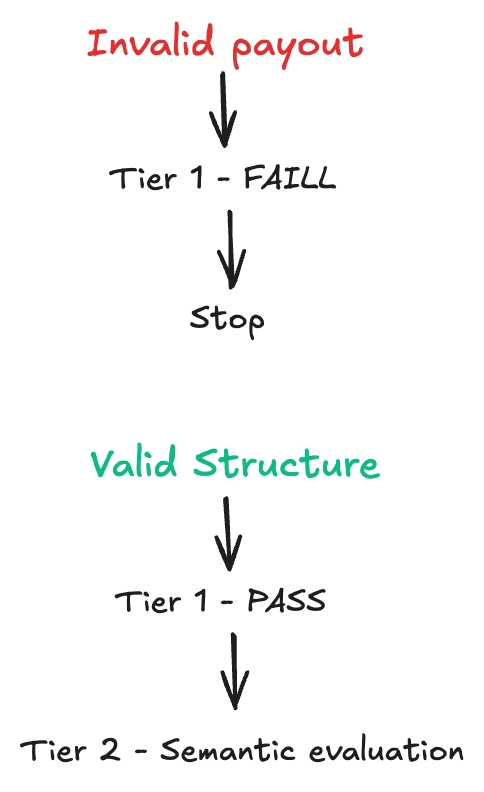
This setup has practical benefits when the evaluation dataset grows.
What the Evaluation Catches
I tested the setup with both valid and intentionally broken traces.
| Scenario | Tier 1 | Tier 2 | Result |
|---|---|---|---|
| Valid refund | PASS | PASS | Passed |
| Valid rejection | PASS | PASS | Passed |
| Valid escalation | PASS | PASS | Passed |
| Rejection with $30 payout | FAIL | Skipped | Tier 1 |
| Refund without order ID | FAIL | Skipped | Tier 1 |
| High-confidence escalation | FAIL | Skipped | Tier 1 |
| Invented 180-day return policy | PASS | FAIL | Tier 2 |
| Response doesn’t answer customer question | PASS | FAIL | Tier 2 |
This is the part I find most useful.
The evaluation suite doesn’t just tell me that something failed. It tells me what type of failure occurred.
Running the Evals
Because DeepEval integrates with Pytest, the evaluation suite can run as part of a normal CI/CD pipeline.
deepeval test run test_evals.py
A semantic failure can then provide both a score and an explanation, for example:
Metric: Faithfulness
Score: 0.0
Threshold: 0.7
Status: FAILED

Reason:
The response claims that international purchases can be
returned within 180 days, but the retrieved policy states
that international sales cannot be returned.
That’s considerably more useful than a simple:
AssertionError: test failed
Why This Approach Works
The approach separates responsibilities:
Code handles deterministic rules such as schemas, required fields, and business logic. LLM evaluations handle semantics such as grounding and relevancy. Fast-fail avoids unnecessary LLM calls when deterministic checks already fail.
Key Takeaways
- Don’t use string matching for everything. LLM outputs are probabilistic, so semantic evaluation is often more appropriate.
- Don’t use LLMs for things Python can check. Keep business rules deterministic.
- Fail fast. Skip expensive semantic evaluations when basic validation already fails.
- Test more than the final answer. For AI agents, the execution trace, tool calls, decisions, and retrieved context can all become part of the evaluation.
If you are interested, here is the GitHub link to the Agent Eval.