
AI-Powered Freelancer Payout Crew
This project is a multi-agent payout workflow built with CrewAI. It simulates the lifecycle of freelancer payments, from validating payout data to checking compliance rules, selecting a payment route, preparing the payment instruction, and creating an audit trail.
The goal was to explore how agent-based workflows can make a finance process more structured and easier to review. It is a prototype, not a production payment system.
The Business Challenge
Managing payments for a global freelance workforce is a complex, manual, and time-consuming operation. Finance teams are burdened with:
Compliance risk: Manually screening for Anti-Money Laundering (AML) rules and sanctions is error-prone.
Operational inefficiency: Processing payouts involves multiple steps: data validation, FX conversion, payment method selection, and execution.
High costs: Suboptimal currency exchange and payment method selection can eat into margins.
Audit headaches: Creating a clear audit trail for later review is time-consuming when decisions are spread across emails, spreadsheets, and payment tools.
Technical Architecture at a Glance
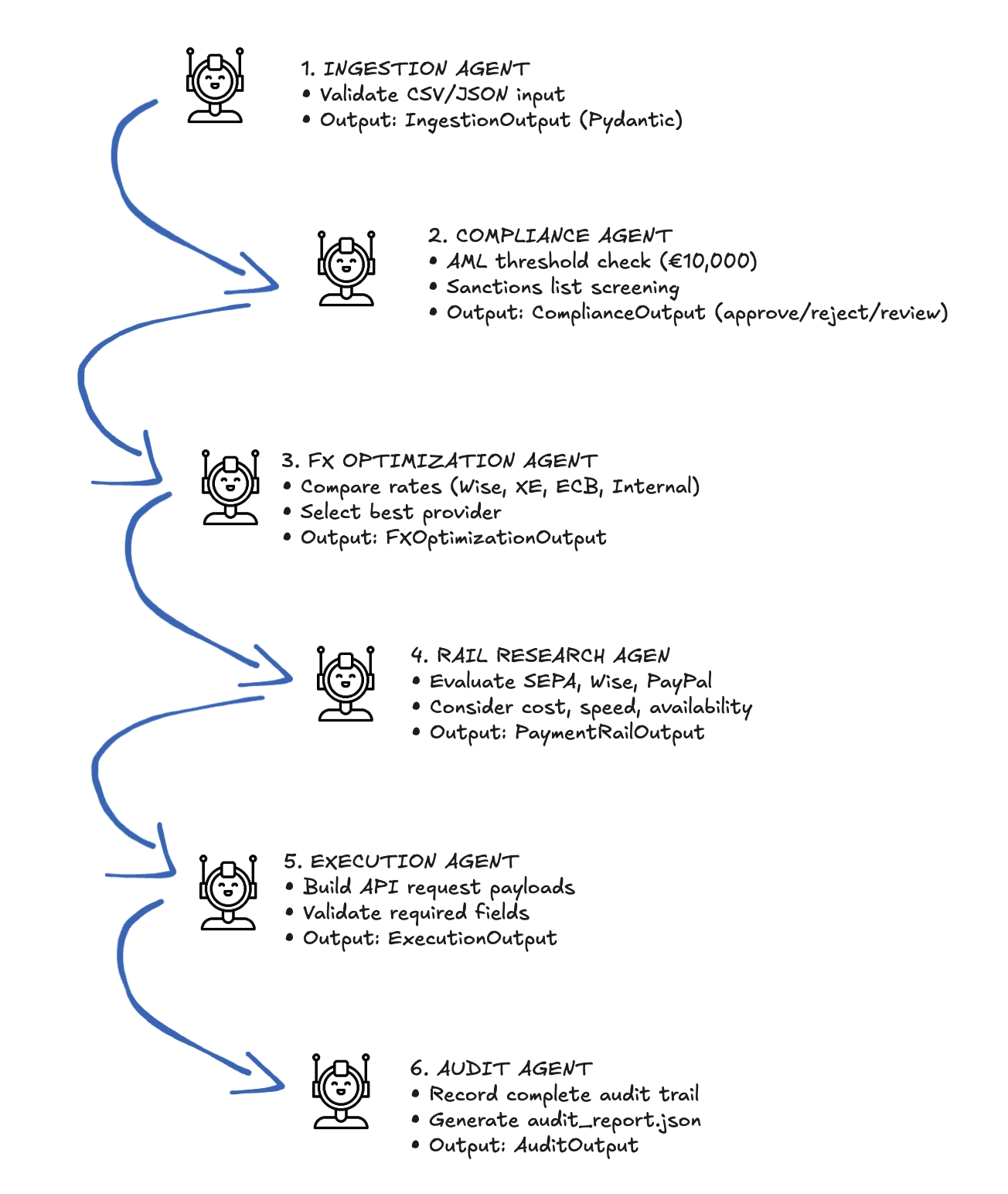
This automation system is built with CrewAI and uses a sequential workflow where each specialist agent hands off its output to the next step. Data is validated with Pydantic BaseModel schemas to keep inputs and outputs consistent.
The modular design makes it easier to add new payment methods or compliance rules without rewriting the full workflow.
Meet the CrewAI Team
The Data Validator: Ingests and cleans possibly messy payout data before anything is processed.
The Compliance Officer: Screens payments against simple AML-style rules, including an enhanced review threshold for larger payments, and returns a clear approve or reject decision with reasons.
The FX Optimizer: Compares available exchange-rate options for cross-border payouts.
The Route Planner: Selects a payment method, such as SEPA, Wise, or PayPal, based on cost, speed, location, and available banking details.
The Executor: Prepares payment instructions for the chosen method, with checks before the instruction is considered ready.
The Auditor: Records the main actions, decisions, and reasons so the workflow can be reviewed later.
Key Business Value
- Reduced manual effort: The workflow shows how data validation, routing, and audit logging can be automated.
- Compliance-minded design: Rules and checks are explicit, which makes the decision process easier to inspect.
- Cost optimization: FX comparison and payment rail selection can help reduce unnecessary fees.
- Auditability: Decisions are logged with enough context to explain what happened and why.
- Extensibility: The system can be expanded with new payment providers, compliance checks, or standards such as Agent Payment Protocol (AP2).
Summary of System Value
| Aspect | Feature | Business Value |
|---|---|---|
| Compliance | AML-style checks, enhanced review threshold, audit log | Makes review easier and reduces the chance of unmanaged risk. |
| Efficiency | FX optimization, payment rail selection | Reduces manual comparison work and can lower transaction costs. |
| Operations | Multi-agent workflow, Pydantic type safety, modular design | Keeps the process structured, repeatable, and easier to extend. |