Building a Privacy-First Local RAG
Organizations often face two competing needs: they want AI to help people find information faster, but they also need sensitive data to stay inside a controlled environment. Traditional search can return raw documents without enough context, while cloud AI tools may not be suitable for private internal files.
With this project, I built a local Retrieval-Augmented Generation (RAG) chat application. It combines a local data retrieval pipeline with local LLMs served through Ollama.
What I Built
This project is a practical demonstration of a self-contained RAG pipeline for private knowledge access. Documents are processed locally, stored in a local vector database, and retrieved as context for the model.
The RAG pipeline retrieves relevant chunks from ChromaDB and provides them as context to the local LLM through Ollama. This helps the model answer from the source material instead of relying only on general training data.
Technical Architecture & Implementation
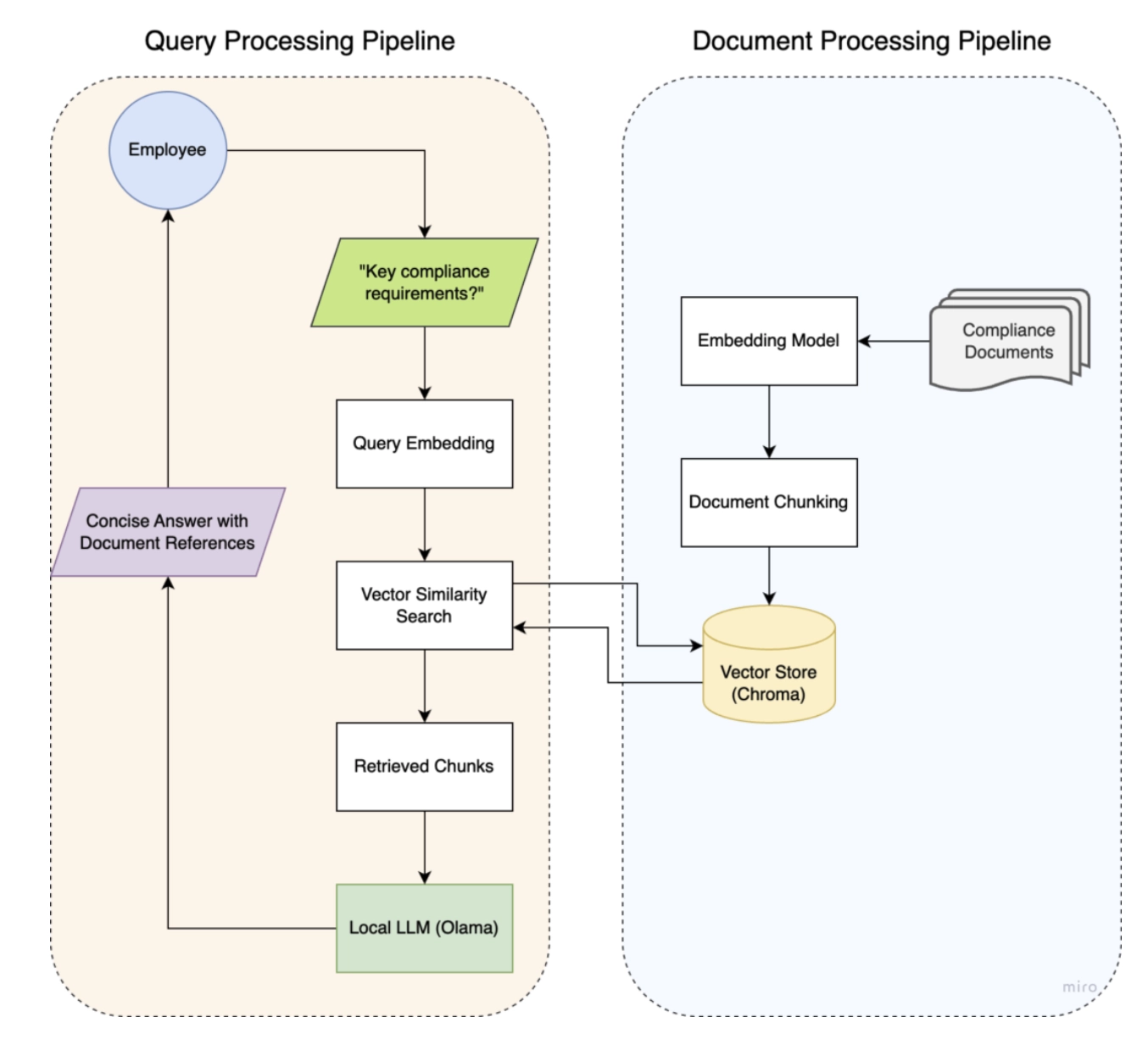
This full-stack application was built with a modern, local-first tech stack.
| Layer | Technology | Implementation Role |
|---|---|---|
| Frontend | React + TypeScript | Interactive chat interface with real-time streaming and source citation display. |
| Backend & API | FastAPI (Python) | High-performance backend serving the RAG workflow and application logic. |
| AI Orchestration | LangChain | Orchestrated the RAG pipeline, including document loading, splitting, and retrieval. |
| Vector Database | ChromaDB | Local vector store for fast and efficient similarity search on document embeddings. |
| LLM Runtime | Ollama | Managed and served local LLMs such as Mistral or Llama models. |
| Embedding Models | nomic-embed-text / text-embedding-3-large | Generated vector representations for text chunks. |
The system follows a standard RAG pattern that can run locally:
- Document processing: User-provided documents are split into manageable chunks using a RecursiveCharacterTextSplitter.
- Vectorization: Text chunks are converted into embeddings and stored in the local ChromaDB instance.
- Retrieval and generation: User queries are embedded and used to find relevant chunks. Those chunks are passed to the local LLM, which generates a grounded answer.
A Practical Use Case
Imagine an HR employee needs to find a specific detail in the company’s 100-page policy handbook. Instead of manual browsing:
- They ask in the chat interface, “What is the paternity leave policy for employees in Germany?”
- The system queries the ChromaDB vector store, retrieving the most relevant passages from the handbook.
- The local LLM generates a concise, easy-to-understand answer, directly citing the sections and page numbers of the source material.
This workflow saves time and makes the answer easier to verify because the response is connected to source material.
Why This Project Matters
- Data security: Local operation helps keep sensitive documents inside the user’s environment.
- More grounded answers: By grounding responses in actual documents, the system reduces the risk of unsupported answers and makes verification easier.
- Operational flexibility: The modular architecture makes it easier to swap models or add new document types.
- Lower API dependency: Running locally can reduce reliance on external inference APIs for private workflows.
If you are interested, here is the GitHub link to the Local Chat RAG.